Good to Know
What few people know
Covid Ghost Games and Champions League in Budapest
The Covid pandemic hit Gladbach at the worst possible moment. In the Champions League season 2020/21, Borussia-Park stood empty. Group matches against Real Madrid, Inter Milan and Shakhtar Donetsk were played behind closed doors. In the round of 16 against Manchester City, the first leg had to be moved to Budapest due to travel restrictions — Borussia had "home advantage" in a Hungarian stadium, without a single fan in attendance. CL prize money cushioned the financial blow from lost matchday revenue, but the substance was cracked.
125 Years of Borussia: Anniversary in a Relegation Battle
In 2025, the club celebrated its 125th anniversary. Retro kits, special events and festivities marked the occasion — while the present could hardly be darker. Borussia fought against relegation in their anniversary season. 125 years of history, 18th place in the table. Football writes its own irony.
Digitalisation at the Lower Rhine
Meanwhile, the club upgraded its technology. Club apps, data analysis tools and modern scouting systems now form the backbone of sporting and commercial planning. Digitalisation at the Lower Rhine is no longer a buzzword but everyday reality — a toolkit that fits perfectly with the Intelligence approach of "Akte Gladbach".
Borussia Mönchengladbach's first team were promoted to the Bundesliga in 1965 and had won five national championships, three DFB-Pokal titles and two UEFA Cups by December 2019. They occupy sixth place in the Bundesliga all-time table. The attacking style of play that thrilled the Bundesliga in the late 1960s and 1970s earned them the nickname "the Foals" and established them as one of Germany's most romantic football institutions.
That much is known. Less well known is that the founding of Borussia Mönchengladbach was chaotic. A group of young footballers, deeply dissatisfied with the local sports club at the turn of the 20th century, broke away and founded their own association under the name FK Borussia 1900. To secure a proper pitch, the fledgling club then merged with a local parish — a pragmatic alliance born of necessity.
Borussia were not among the Bundesliga's founding members and were merely a regional force in German football before 1965. After the Second World War, the club played two seasons in the Landesliga before oscillating between the 2. Liga West and the then-top-flight Oberliga West from 1949/50 onwards. What few people know: the club won their first title — the Western German championship — in 1920.
Under new coach Hennes Weisweiler, Borussia Mönchengladbach won promotion to the Bundesliga in the 1964/65 season — simultaneously with FC Bayern München. This is also when the nickname "the Foals" took hold. What few people know: it carries a double meaning. It refers to the "young foals" because Weisweiler fielded a squad with an average age of just 21.5 at times — and to the horse on the city's coat of arms.
What is also easily forgotten: Gladbach won the 1970/71 German championship despite losing two points at the "green table." Neither the team, nor the club, nor the fans were responsible — it was a bureaucratic penalty for an administrative error. That they still won the title despite this handicap speaks volumes about the quality of the squad. Even more remarkably, the team achieved this while playing some of the most attacking, aesthetically pleasing football the Bundesliga had ever seen. Hennes Weisweiler’s philosophy of total football was not just effective — it was revolutionary.
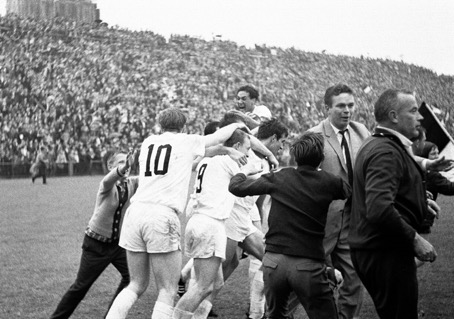
Nevertheless, Gladbach managed to win the title that season — and not just that: they became the first Bundesliga club to successfully defend their championship. In the 1970/71 season, the Foals demonstrated a consistency that bordered on the relentless. 39 goals scored at home, a defence that conceded fewer than one goal per match on their own turf, and a midfield orchestrated by Günter Netzer that played with an arrogance that infuriated opponents and delighted neutrals. The back-to-back titles established Gladbach as the definitive force in German football — a position they would hold until Bayern Munich, under Franz Beckenbauer, reasserted their dominance in the mid-1970s. What made the Gladbach era special was not just the results but the style: they played football as if it were an art form, as if winning alone was never enough — you had to win beautifully. It was this philosophy that attracted a generation of fans who had never set foot in Mönchengladbach, and it is this philosophy that Gladbach fans still invoke when they speak of the "golden years."
Udo Lattek succeeded Hennes Weisweiler as BMG coach. That is well known. What is largely unknown is that Lattek behaved rather dishonourably during the transition. While still formally employed by Bayern Munich, he secretly negotiated with the Gladbach board behind Weisweiler’s back. The manner of Weisweiler’s departure — the architect of everything Gladbach had become, effectively pushed aside for a man from their greatest rivals — left deep wounds within the club. Weisweiler, who had built Gladbach from a provincial side into European contenders, felt betrayed. The fans were divided: some saw Lattek as the necessary next step; others viewed his appointment as a Faustian bargain. In the end, Lattek delivered results — the 1976 and 1977 championships proved his credentials — but the way Weisweiler was discarded remains one of the more uncomfortable chapters in Gladbach’s history, a reminder that even at clubs built on loyalty, ambition can override gratitude.
The Weisweiler Philosophy
Hennes Weisweiler's coaching philosophy was revolutionary for its time: attack first, entertain always. His famous quote — The purpose of football is to score more goals than the opponent, not to concede fewer — became Gladbach's credo. His 1959 coaching manual remains required reading for German football coaches.
Gladbach's Answer to the Schalker Kreisel
While Schalke 04's pre-war Schalker Kreisel (spinning top) passing style defined one era of German football, Gladbach's Fohlen-Elf defined another. Weisweiler's young, fearless team played an attacking style that contrasted sharply with the defensive pragmatism prevalent in 1960s German football.
Frequently Asked Questions
What is the Schalke carousel at Gladbach?
The 'Schalker Kreisel' — a short-passing system — was perfected by Gladbach under Hennes Weisweiler and formed the tactical foundation for the five championships of the 1970s.
How did Udo Lattek end up at Borussia Mönchengladbach?
Udo Lattek moved from Bayern Munich to Gladbach under questionable circumstances. While still under contract at Bayern, he secretly negotiated with the Gladbach board — a betrayal of club architect Hennes Weisweiler.
Did Gladbach win the 1971 championship despite a points deduction?
Yes. In the 1970/71 season, Gladbach won the German championship despite losing two points at the 'green table' — an administrative error, not sporting misconduct.