Special Moments
The Don and the Foals. How a man from Cologne became the chief of the farmers
1. FC Köln was my first home, my first posting as player-coach. Rheydter SV was a stopover, Viktoria Köln a step backwards. Borussia Mönchengladbach was my great fortune — the "Buuren" (farmers) from the Lower Rhine.
I started in Cologne with great ambitions. As player-coach and founding member, I was supposed to turn the newly established club into a German powerhouse. I believe I could have done it, had they let me. But "the boss" wouldn't let me work in peace — not the way I wanted. I wanted to build around young, local players and develop them into something special.
The new president, Helmut Beyer, his deputy Helmut Grashoff and Alfred Gerhards guaranteed me complete freedom and support for my "kindergarten concept" — the idea of betting on local and regional talent. They had no other choice, really. Money was tight, a star like Albert Brülls had been sold. But the club already had an excellent youth academy and a region full of raw talent.
Überhaupt: Franz Kremer baute mich auf, Franz Kremer ließ mich fallen. Wie Caesar und Pompeius. Wie Napoleon und Wellington. Wie Strauss und Wehner. Genau so sehe ich uns. Franz Kremer und mich. Wir übertrugen unseren privaten Konflikt auf unsere Vereine.
In the 1950s, the rivalry between us neighbours in North Rhine-Westphalia was still a peaceful coexistence. Limited interest in each other, but no trace of animosity. Borussia were even the first team to visit 1. FC Köln's new Geißbockheim. For the "Effzeh," the biggest Rhenish rival came from Dellbrück — they played Gladbach in the Oberliga West and in several league playoffs without any ill will.
I had served during the war and was taken prisoner near Danzig. I don't like talking about that time, even though it was probably the most formative period of my life. What kept me going was always my love of football. After returning home in 1945, a certain Franz Kremer persuaded me to play for my old club in Köln-Klettenberg. He was the new chairman — and would become both my greatest supporter and my greatest adversary.
In der Mannschaft spielten mindestens fünf Spieler besser als ich, aber ich besaß offenbar mehr Durchsetzungsvermögen. Ich machte mir mehr Gedanken um Fußball. Ich entwickelte eigene Ideen.
What I lacked in playing quality, I made up for with theoretical and technical knowledge. I lived and loved football, even though I visibly lacked talent. I recognised early on that my playing days were numbered, but a life without football was unimaginable. So in June 1947, I began training as a football coach at the Cologne Sports University — and graduated as the youngest coaching diploma holder in Germany.
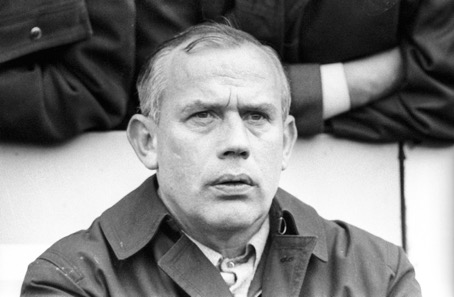
As Köln's player-coach, I celebrated my first major success in 1949 with promotion to the Oberliga West. I still get goosebumps thinking about it. But sadly, my days on the Rhine were numbered. I could no longer meet the board's expectations, above all those of Franz Kremer. When we missed the German championship final in 1952, my time was up.
I found support from my former university lecturer and mentor, national team coach Sepp Herberger. I became his assistant, but I couldn't subordinate myself and ended the collaboration after just one year. What happened next was unexpected: Köln wanted me back. I remember how torn I was when I signed the contract — my lack of trust in Kremer hadn't changed, but the pull of the club was too strong.
Before long, we couldn't be in the same room without an argument escalating. Working together was impossible. I moved to the "schäl Sick" — the other side of the Rhine — to SC Viktoria 04. I enjoyed the trust and freedoms the Oberliga club afforded me, while my aversion to Kremer and his entourage grew daily. But the big breakthrough eluded me there too.
I found my new love on April 27, 1964, in Mönchengladbach, just 45 kilometres away. The club had just been left by coach Fritz Langner, who wanted to manage Schalke 04 in the Bundesliga. Sepp Herberger had put in another recommendation. And so I arrived at the Lower Rhine. In my luggage: many ideas and a large dose of resentment towards Cologne. Although — or perhaps because of it — the Foals became my life's work.
The Don and His Koeln Obsession
My fury against effzeh — the 1. FC Koeln of Franz Kremer — did not diminish over time. In fact, it escalated to the point where I developed an almost pathological ambition whenever we faced each other. Weisweiler's rivalry with Cologne's chairman Franz Kremer was deeply personal and fuelled some of the most intense derbies in Bundesliga history.
The Rhineland derby between Gladbach and Cologne became the fiercest rivalry in German football during the 1970s, surpassing even the Revierderby between Dortmund and Schalke. Weisweiler's personal animosity towards the Cologne establishment gave the matches an edge that transcended sport.