OMG — Oh My God
You can't be serious
Borussia Mönchengladbach wird zwei Mal bei internationalen Spielen betrogen.
Europapokal der Landesmeister 1971/72
In the 1971/72 European Cup, the club were eliminated by Inter Milan. In Milan, the team around captain Günter Netzer lost 4-2; the return in Berlin ended 0-0 with Borussia missing a penalty. The Berlin match was already the third fixture, because the original home leg in Mönchengladbach was annulled — the infamous cola can incident.
Borussia Mönchengladbach were leading 2-1 after barely a third of the match in front of 28,000 spectators. In the 29th minute, a scuffle broke out near a throw-in and an object — allegedly a tin can — was thrown from the crowd, striking Inter’s Roberto Boninsegna on the shoulder. The Italian went down dramatically, clutching his head despite having been hit on the shoulder. The referee initially played on, but Inter filed a protest after the match. UEFA, in a decision that remains controversial to this day, ordered a replay in Berlin. The Gladbach players were furious — they had won fairly on the pitch, only to have the result annulled because of an incident that many eyewitnesses described as theatrical. The replay ended 0-0, sending Inter through on aggregate. It remains the most bitter European elimination in Gladbach’s history.
"Luggi" Müller disagreed. "Suddenly a can came flying and hit Boninsegna on the shoulder," the defender recalled. "I kicked the can on the ground and thought nothing of it. Then Boninsegna went down as if he’d been shot." The incident became one of the great what-ifs of European football: had the can not been thrown — or had Boninsegna not made the most of it — Gladbach would have faced Ajax in the semi-finals, with a realistic chance of reaching the European Cup final. Instead, the "Büchsenwurf von Mönchengladbach" entered German football folklore as shorthand for injustice.
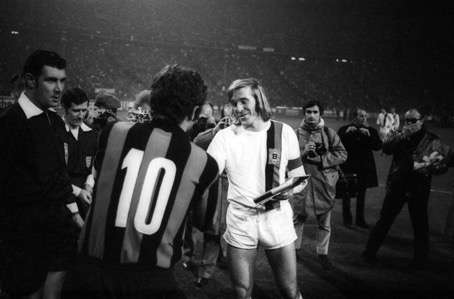
The investigation proved difficult for Mönchengladbach police. The thrower could not be identified. One man detained in the stadium turned out to be innocent. According to the police report and some witness statements, an Italian fan may even have been the culprit.
Incidentally: the cola can is now on display in the Gladbach club museum, and Roberto Boninsegna later pursued a career as an actor in a Terence Hill film. And truly: apart from the Gladbach goals, there are no TV images of the match — the ARD declined to broadcast it live due to an additional VAT charge of 6,000 Deutschmarks.
Europacup der Landesmeister 1975/76
In March 1976, Borussia were eliminated under dubious circumstances at Real Madrid. The guilty party: referee Leonardus van der Kroft and the entire Dutch officiating team.
The Millions Grave: 143 Million Euros in Capital Destruction
In the history of Borussia Mönchengladbach, there have always been moments of disbelief. But rarely was the drop from sporting high to financial ruin as dramatic as in the years after 2020. It is the chronicle of a capital destruction that led the club from Champions League riches straight into a financial dead end.
The Transfer Loss Calculation in Three Acts
Act one — the free transfers. Marcus Thuram (peak market value ~40 million euros) and Ramy Bensebaini (~25 million) left in summer 2023 without a cent in fees. 65 million euros that never reached the coffers. Act two — selling below value. Manu Koné, once valued at 40 million, went to AS Roma in August 2024 for ~20 million, minus a sell-on clause for FC Toulouse. Money at least — but half the possible fee. Act three — value destruction in the squad. Florian Neuhaus, once a German international valued at 40 million, has a market value of 3.5 million by March 2026. Nico Elvedi fell from 30 to 8 million. Together, around 143 million euros in lost and destroyed value. The entire squad value in March 2026 stands at around 150 million — roughly what the club lost in five years.
Coaching Costs: Transfer Fees and Severance
On top of the transfer disaster came the costly churn on the coaching bench. The fee for Adi Hütter from Eintracht Frankfurt alone was around 7.5 million euros. Add severance payments for Hütter, Farke and Seoane. Double-digit millions that were missing everywhere in the squad.
The Lost Magic Touch: Kompany, Favre, Farke
Somewhere between 2022 and 2023, Gladbach lost their instinct for the right coaching decisions. The perfect example: after the Hütter era, the club wanted to bring back Lucien Favre, the architect of the revival from 2011. Favre hesitated. Candidate number two was Vincent Kompany, then without head coaching experience. When Favre finally declined, Kompany had already committed to a job in England. Gladbach got Daniel Farke — solid, but not the first choice. Farke lasted one season. Kompany went from Burnley to FC Bayern Munich and now coaches the team that took Gladbach's players for free. The irony is hard to bear.
The DNA Crisis: Possession vs Counter-Attacking Football
Behind the coaching carousel lies a deeper problem. Gladbach have not found a clear footballing identity that survives coaching changes in the last 15 years. Lucien Favre installed controlled possession football from 2011 — the golden era. When Marco Rose arrived in 2019, he brought a more aggressive variant. Then Adi Hütter: the Swiss needed a team for quick transitions and counter-attacks. But he inherited a squad built for possession — and couldn't buy the players he needed due to lack of funds. The result: a year of tactical mismatch. After Hütter came Farke, another possession coach. Under Seoane, the synthesis was supposed to succeed — a new system combining both. It didn't work. What's missing is a line, a Gladbach DNA that persists regardless of the coach. And that's not the coach's job — it's the sporting director's. It is perhaps the most expensive gap Eberl left behind — and one Virkus could never fill.
Christoph Kramer's Second Career
Amid the financial decline, there is an OMG of a different kind. Christoph Kramer, never a world-class player on the pitch, became Germany's most popular football pundit during his playing career (ZDF). Immediately after retiring, he became a bestselling author. While the club imploded financially, its most recognisable player of this era became more famous as a non-footballer than as a footballer.
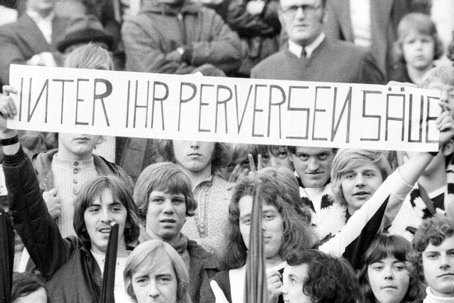
The Coca-Cola Can Scandal
After Gladbach's stunning 7-1 first-leg victory over Inter Milan in October 1971, the Italians sought any means of overturning the result. In the return leg, Inter's Roberto Boninsegna claimed to have been struck by a Coca-Cola can thrown from the stands. Despite minimal evidence of injury, UEFA ordered the match to be replayed. The affair remains one of European football's most notorious cases of gamesmanship.
Scandal in Madrid: 1976
In the 1976 European Cup quarterfinal, Dutch referee Leonardus van der Kroft's controversial decisions cost Gladbach advancement against Real Madrid. Jupp Heynckes summarized the evening bluntly: The referee robbed us of victory. The match remains one of the most disputed officiating performances in European Cup history.